
PDU Mass Deployment Made Simple: Introducing uPDU for Global Data Centers

Electricity is one of the essential utilities in a computing environment. And while the physics of electricity (illuminated by greats like Faraday, Edison, and Tesla) is constant, there’s considerable diversity in how power is transmitted and distributed worldwide.
Take, for example, the deployment of 415 Volt power in North American data centers. In 2023, this isn’t particularly newsworthy. Fifteen years ago, it was novel. Around that time, big data center operators in North America proposed this “international” voltage as an avenue to greater data center efficiency—smaller transformers, fewer losses, and better utilization of power supplies.
Electrical diversity has conditioned us to look at electricity through regional silos. Still today, the prevailing practice is to segment power products according to regional electrical standards and regional conformance bodies like UL & CE. Therefore, any global enterprise likely has unique PDUs for each country/region in which they operate. This leaves a supply chain organization with more to manage—inventory levels, BOMs, configurations—and more opportunity for error.
The Panduit Universal PDU (uPDU) offers an avenue to address PDU deployment challenges.

As soon as a cord/plug is hardwired to a PDU, it becomes regional—the opposite of ‘universal’ and the cause of the supply chain complexities mentioned above. The uPDU is deliberately sold absent a cord and plug and instead offers (12) potential choices called facility side cables.
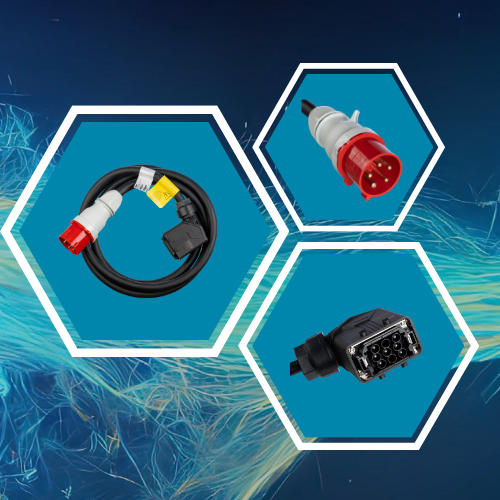
Consumers will choose the appropriate cable depending on the installation location and capacity required. The two components—PDU and cord—then mate on-site with no required tools.
Facility Side Cordsets
| Part Number | Description | Drop-Down Menu in Web GUI. | Apparent Power (kVA) | Input Voltage (V) | Input Phase |
|---|---|---|---|---|---|
| UPDUCRD1 | UPDU to IEC 60309 3P+N+E 6h 32A (IP44), CORD SET, 3M (10FT) | 32A3WYE | "17.3 (NAM) 22.0 (EMEA)" | 415 | 3 |
| UPDUCRD2 | UPDU to IEC 60309 2P+E 6h 60A (IP44), CORD SET, 3M (10FT) | "60A1L-L (NAM) 60A1L-N (EMEA)" | 10 | 208 | 1 |
| UPDUCRD3 | UPDU to IEC 60309 3P+E 9h 60A (IP44), CORD SET, 3M (10FT) | 60A3DLT | 17.3 | 208 | 3 |
| UPDUCRD4 | UPDU to CS8365C 50A, CORD SET, 3M (10FT) | 50A3DLT | 14.4 | 208 | 3 |
| UPDUCRD5 | UPDU to IEC 60309 3P+N+E 6h 63A (IP44), CORD SET, 3M (10FT) | "60A3WYE (NAM) 63A3WYE (EMEA)" | "23.0 (NAM) 27.6 (EMEA) BREAKER LIMITED" | 415 | 3 |
| UPDUCRD6 | UPDU to IEC 60309 3P+N+E 6h 20A (IP44), CORD SET, 3M (10FT) | "20A3WYE (NAM) 16A3WYE (EMEA)" | "11.5 (NAM) 11.0 (EMEA)" | 415 | 3 |
| UPDUCRD7 | UPDU to L6-30P 30A, CORD SET, 3M (10FT) | 30A1L-L | 5 | 208 | 1 |
| UPDUCRD8 | UPDU to IEC 60309 2P+E 6h 20A (IP44), CORD SET, 3M (10FT) | "20A1L-L (NAM) 16A1L-N (EMEA)" | "3.3 (NAM) 3.6 (EMEA)" | 240 | 1 |
| UPDUCRD9 | UPDU to IEC 60309 2P+E 6h 32A (IP44), CORD SET, 3M (10FT) | "30A1L-L (NAM) 32A1L-N (EMEA)" | "5.0 (NAM) 7.4 (EMEA)" | 240 | 1 |
| UPDUCRD10 | UPDU to L21-30P 30A, CORD SET, 3M (10FT) | 30A3WYE | 8.6 | 208 | 3 |
| UPDUCRD11 | UPDU to L15-30P 30A, CORD SET, 3M (10FT) | 30A3DLT | 8.6 | 208 | 3 |
| UPDUCRD12 | UPDU to CS8265C 50A, CORD SET, 3M (10FT) | 50A1L-L | 8.3 | 208 | 1 |
* User must select the appropriate drop down from WebGUI menu to achieve stated power metering accuracy.
For a full listing of part numbers including related products, please visit here
The uPDU capacity ranges from 3.3kVA to 27.6 kVA. The internal wiring is sized for the maximum possible current, making it safe to operate at all levels.
Use Cases
Consistency: A user can deploy the same PDU everywhere and stock only the cords needed at each location.
Compliance: Universally compliant PDUs that meet international standards for PDUs[FM3] [RL4]
- USA & Canada: UL/EN/IEC 62368 PDU
- Europe - CE/UKCA Approved
- Australia - RCM Approved
- Brazil: Approved
- Chile: Approved
- Peru: Approved
- United Arab Emirates (UAE): Approved
- India: Approved
- China: Approved
- Hong Kong: Approved
- Singapore: Approved
Adaptability: A recently acquired company faced changing rack power requirements as it had to move its IT gear into the data center of its new owner—one with a completely different power infrastructure. All the existing PDUs had to be scrapped for new models to accommodate these changes. In the same scenario, the uPDU offered a versatile solution, as it could be repurposed in the new environment simply by swapping the facility side cables, thus addressing the altered rack power demands efficiently.
Sustainability: Sustainability is more important than ever. The previous example speaks to it. Traditional rack PDUs may contribute to e-waste when replaced, and new product packaging and transportation can have environmental impacts. Not only do uPDUs keep PDUs from getting scrapped, but data centers save on the packaging and transportation that new products would require.
Summary
The uPDU is a departure from a conventional PDU—not applicable to all consumers but a difference maker for those who operate globally or who have diverse electrical systems to work within.
To learn more about Panduit Critical Power Solutions offering, please visit here.




- 3 risques liés aux chemins de câbles et comment les prévenir grâce à une gestion efficace du câblage
- Fault Managed Power: les réponses aux questions les plus fréquentes
- Concevoir pour des environnements en constante évolution
- Un produit invisible… Jusqu'à ce qu'un court-circuit se produise
- Quand le moins cher finit par coûter plus cher : les coûts cachés des PDU à bas coût
- Intelligence artificielle
- Audiovisuel (AV)
- Haut débit
- Infrastructure cloud
- Construction
- Alimentation électrique critique
- Cybersécurité
- Centre de données
- ESG
- Infrastructure électrique
- Électrification
- Entreprise
- Solutions de connectivité par fibre optique
- Réseau de distribution informatique
- Identification
- Centre de données multi-locataires
- Infrastructure réseau
- OEM
- Énergies renouvelables
- Sécurité
- Bâtiments intelligents
- Témoignages de réussite
- Développement durable
- Automatisation des entrepôts